

Sewer Pipe Leak Under Slab: Warning Signs and Solutions

A sewer pipe leak under slab is one of the most serious plumbing issues home and business owners can face. Hidden beneath concrete, these leaks often go unnoticed until the damage becomes severe, impacting your foundation, flooring, and even indoor air quality.
As slab leak detection for sewer pipes are among our core services at Pipe Restoration Solutions (PRS), our team understands how quickly these problems can escalate and why a fast, professional assessment is essential to mitigating damage and preserving your property.
Quick Guide: Sewer Pipe Leak Under Slab
Before we dive deeper, here’s a quick reference guide to help you understand the risks, symptoms, and professional solutions available for sewer pipe leaks under your slab.
| Category | What to Know |
|---|---|
| Why It Happens | Pipe corrosion, improper installation, failed joints, or tree root intrusion |
| Common Warning Signs | Foul odors, foundation cracks, slow drains |
| Why It’s Urgent | Delayed action can cause major foundation damage and costly reconstruction |
| How We Diagnose It | Advanced sewer camera inspection, slab leak detection tools, and pressure testing |
| Best Repair Options | Trenchless Cured-in-Place Pipe (CIPP) lining technology, spot repair, rerouting, or full system restoration |
| Benefits of Trenchless Repair | Minimal demolition, long-term durability, and faster turnaround with trenchless methods |
Reach out today for diagnostics for your sewer pipe leaks.
Early Warning Signs of Sewer Pipe Leaks Under Slabs
| Warning Sign | What It Indicates | Urgency Level |
|---|---|---|
| Foul sewage odors indoors or in yard | Sewage escaping into soil around foundation | High |
| Wet spots on floors or carpets | Wastewater or sewage surfacing through slab | Critical |
| Foundation cracks appearing | Soil erosion weakening structural support | Critical |
| Mold or mildew growth along baseboards | Moisture infiltration from leak | High |
| Standing water pooling near foundation | Sewage or water accumulating underground | Critical |
| Unusually green patches in lawn | Extra moisture feeding grass above leak | Medium |
Why You Should Never Ignore the Warning Signs
If you notice persistent sewage odors, damp flooring, mold, or unusually slow drains, there’s a strong chance you’re dealing with a sewer pipe leak under the slab.
A leak under the slab is more than a plumbing issue. The wastewater leak can soften and erode the soil supporting the foundation, creating voids that may lead to cracking, settlement, or structural movement. That’s why these types of leaks require immediate attention.
When left unaddressed, deterioration continues and damage increases, often resulting in more invasive repairs and higher restoration costs.
What Causes a Sewer Pipe Leak Under a Slab?
Most property owners are unaware of the condition of the sewer pipes beneath their foundation until something goes wrong. Sewer pipe leaks under a slab most commonly result from soil movement, corrosion in aging cast-iron systems, or tree root intrusion at vulnerable pipe joints. Over time, minor defects can grow into significant failures.
Soil Movement and Foundation Shifts
Expansive clay soils are a leading cause of under-slab sewer pipe failures in many regions. When clay soils absorb moisture, they expand; during dry conditions, they contract. This constant expansion and contraction places stress on pipes beneath or within concrete slabs, increasing the risk of cracking, joint separation, and leaks.
Pipe Corrosion and Material Failure
Pipe material plays a significant role in how and when failures occur:
- Cast iron pipes (commonly installed in homes built before the 1970’s): While durable initially, cast iron corrodes over time. Interaction with surrounding soil and wastewater gradually thins and weakens the pipe walls, leading to scaling, cracking, and eventual leaks.
- Galvanized steel pipes: As protective zinc coatings deteriorate, internal corrosion and mineral buildup develop, weakening the pipe and increasing the likelihood of failure.
- Plastic pipes (ABS, PVC, CPVC, PEX): These materials resist corrosion but are still vulnerable to joint separation, improper installation, or movement beneath the slab. In some cases, PEX piping may develop leaks due to continuous vibration or shifting conditions.
Poor Installation Practices
Substandard installation during construction can significantly increase the risk of pipe failure. Common issues include:
- Inadequate pipe bedding that allows excessive movement
- Improperly installed joints or couplings that lead to separation or leakage
- Insufficient pipe support creating stress points
- Improper transitions between dissimilar materials, such as cast iron to PVC
External Pressures
Tree roots seek moisture and nutrients, allowing them to penetrate small cracks or compromised joints in sewer lines. Once inside, roots expand, causing blockages and accelerating pipe deterioration. Additionally, some soil conditions can contribute to long-term corrosion of certain pipe materials over extended periods.
Why Professional Assessment Is Essential For Sewer Pipe Leaks Under Slab
This is not a DIY situation.
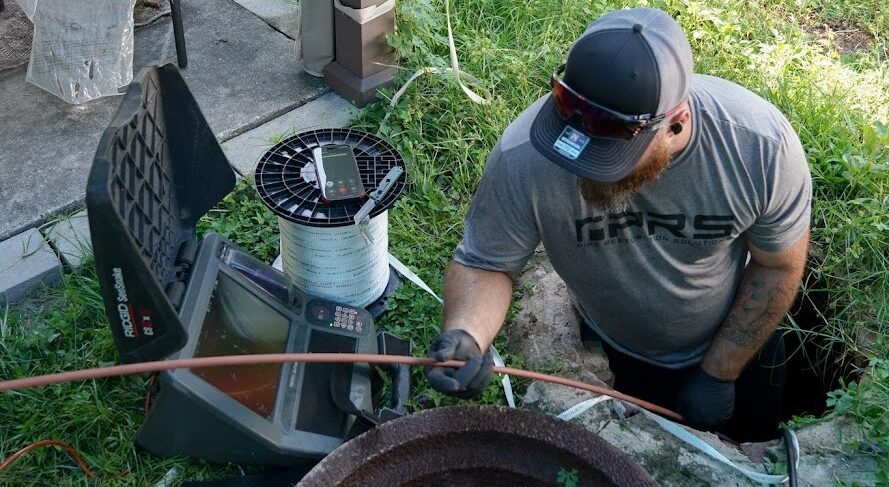
At PRS, our technicians perform a comprehensive sewer camera inspection to locate the exact source of the leak without tearing up your floors. This step is critical because guessing the location can lead to unnecessary demolition and wasted money. With the proper diagnostic tools, we can visually verify pipe conditions, including cracks, separations, or blockages, in real-time.
What’s the Best Repair Method for a Sewer Pipe Leak Under Slab?
If you’re dealing with a sewer pipe leak under a slab, trenchless repair, especially CIPP lining technology, is often the ideal solution. Instead of jackhammering your foundation, trenchless restoration rehabilitates the pipe from the inside.
Benefits of Trenchless CIPP Lining Technology:
- No slab destruction
- Faster turnaround
- Extends the service life of sewer pipes by 50+ years
- Resistant to root intrusion
- Minimal restoration expenses compared to traditional repairs
For home and business owners seeking long-lasting solutions, trenchless repair provides certainty and peace of mind.
How Does Trenchless Epoxy Pipe Lining Work?
After thoroughly cleaning your sewer line, we insert a felt liner saturated with a two-part epoxy resin into the compromised pipe, utilizing existing access points. An internal bladder is then inflated, pressing the liner firmly against the interior pipe walls.
Within hours, the epoxy cures in place, forming a solid, seamless pipe inside the old pipe. The cured liner creates a joint-free, corrosion-resistant pipe that restores full flow capacity. We verify installation with a final camera inspection to confirm the liner has adhered properly and that all service connections remain fully open.
Trust PRS for Expert Under-Slab Sewer Pipe Repairs
If you suspect a sewer pipe leak under your slab, time is critical. Don’t wait until your foundation cracks or sewage backs up into your home to call a professional.
At PRS, we specialize in non-destructive sewer slab leak detection, high-tech camera inspections, and advanced trenchless pipe restoration. With more than three decades of experience and industry-leading equipment, we address sewer pipe failures efficiently while minimizing disruption and preventing future damage.
Related Posts
The Best Sewer Cleaning Companies in Fullerton, CA
Fullerton is one of Orange County’s oldest cities, and many homes and commercial buildings in…
Top Rated Sewer Line Repair in Jacksonville, FL
If you’re dealing with slow drains, foul odors, or recurring backups in your Jacksonville home,…